
Why choose philosophical apparel: style for mindful lives
TL;DR:
- Philosophical apparel uses minimalist designs to promote meaningful values and self-awareness.
- Wearing intentional clothing can enhance mindset and reinforce personal principles through enclothed cognition.
- It suits urban lifestyles by being versatile, durable, and fostering genuine self-expression.
What you wear does more than signal taste. Research on enclothed cognition suggests that clothing can quietly shape how you think, act, and see yourself. For urban young adults seeking more than trend-driven purchases, philosophical apparel offers a practical way to align daily dress with personal values. This guide covers what philosophical apparel is, why it works psychologically, how it fits modern urban life, and how to choose pieces that genuinely support self-improvement. If you have ever felt that your wardrobe should mean something more, this is worth reading.
Table of Contents
- What is philosophical apparel and why does it matter?
- The psychology behind why we wear our values
- How philosophical fashion fits urban lifestyles
- Choosing philosophical apparel: Tips for meaning, comfort, and style
- Why philosophy on your clothes is more than a trend
- Discover apparel that reflects your philosophy
- Frequently asked questions
Key Takeaways
| Point | Details |
|---|---|
| Fashion shapes mindset | Choosing philosophical apparel can positively influence your thoughts and behaviour through enclothed cognition. |
| Minimalism meets meaning | Philosophical fashion offers clean design with a deeper message, perfect for urban self-improvers. |
| Choose with intention | Mindful clothing choices help reinforce personal values and encourage growth in everyday life. |
| Versatile for modern life | Philosophy-inspired style suits work, leisure, and daily routines without sacrificing comfort. |
What is philosophical apparel and why does it matter?
Philosophical apparel refers to clothing designed around meaningful ideas, symbols, or principles rather than purely aesthetic trends. It typically features minimalist design, considered typography, and imagery drawn from philosophical traditions such as stoicism, mindfulness, or broader humanist thought. The visual style tends to be clean and restrained, allowing the message to carry weight without visual noise.
The connection to stoicism is particularly relevant for young urban adults. Stoic philosophy, practised by figures such as Marcus Aurelius and Epictetus, centres on focusing only on what you can control, accepting impermanence, and acting with intention. When these ideas appear on a garment, they serve as a quiet, wearable prompt. You do not need to recite a passage from Meditations each morning if the principle is already on your chest.
Minimalist design reinforces this. Fewer elements mean each one carries more significance. A single symbol or short phrase on a well-cut garment communicates more clearly than a cluttered graphic. This is why philosophy-inspired fashion has found a steady audience among people who value substance over spectacle.
“Enclothed cognition links what you wear with how you think and act, suggesting that the symbolic meaning of clothing directly influences the wearer’s psychological state.”
Philosophical apparel also supports self-reflection. Seeing a meaningful phrase or symbol each time you dress creates a brief but consistent moment of pause. Over time, these small moments accumulate.
Here are the main reasons people choose philosophical apparel:
- Meaning: Each piece carries a concept or value, not just a colour or cut.
- Self-expression: It communicates identity without requiring explanation.
- Simplicity: Minimalist design reduces decision fatigue and visual clutter.
- Daily reminder: Wearable prompts reinforce values throughout the day.
- Authenticity: It reflects genuine beliefs rather than brand loyalty to a logo.
For anyone building a wardrobe with purpose, these qualities make philosophical apparel a practical and considered choice.
The psychology behind why we wear our values
The concept of enclothed cognition was examined by researchers Hajo Adam and Adam Galinsky, who found that wearing a garment associated with specific qualities could enhance the wearer’s performance of those qualities. In simple terms, what you wear affects how you behave. The psychological support for this comes from both controlled studies and a wide range of personal accounts from people who report feeling more focused, grounded, or motivated when dressed with intention.
| Factor | Psychological research | Anecdotal reports |
|---|---|---|
| Mindset shift | Documented in lab studies | Widely reported by wearers |
| Behaviour change | Linked to symbolic meaning of clothing | Described in brand reviews |
| Self-perception | Improved confidence noted | Consistent across user feedback |
| Long-term habit | Limited longitudinal data | Reported as a daily anchor |
The cycle works like this: dressing with intention prompts intentional action. When you choose a garment that reflects a value you want to embody, you carry a visual cue with you all day. That cue reinforces the value each time you notice it, whether in a mirror, a window reflection, or simply by remembering what you put on.
Many wearers of philosophical apparel describe this as a low-effort but consistent nudge. It does not replace practice or discipline, but it supports both.
Pro Tip: Choose one piece of philosophical apparel that represents a specific habit or value you are working on. Wear it on days when you need that reminder most. Over time, the association between the garment and the intention becomes stronger.
Here are steps for picking apparel that builds your desired mindset:
- Identify the value or principle you want to reinforce.
- Look for designs that represent that principle clearly and simply.
- Choose quality materials so the garment remains a pleasure to wear.
- Wear it consistently in contexts where the reminder is most useful.
- Notice how the garment affects your thinking over several weeks.
For a practical starting point, motivational hoodie designs offer a straightforward way to apply this approach to everyday dress.
How philosophical fashion fits urban lifestyles
Urban life is fast, varied, and often visually saturated. Commuting, coworking spaces, gym sessions, and social engagements all call for clothing that performs across contexts. Philosophical apparel, particularly in minimalist form, is well suited to this kind of versatility.

The comparison below shows how philosophical apparel differs from standard streetwear across key dimensions:
| Dimension | Standard streetwear | Philosophical apparel |
|---|---|---|
| Primary message | Brand identity or trend | Personal value or principle |
| Design complexity | Often graphic-heavy | Minimalist and considered |
| Versatility | Context-dependent | Adapts across settings |
| Effect on mindset | Neutral or trend-focused | Intentional and reflective |
| Longevity | Tied to seasonal trends | Designed for lasting relevance |
It is worth noting that benefits remain largely anecdotal from reviews and brand claims, with no large-scale empirical benchmarks available. That said, the practical advantages of minimalist design are straightforward regardless of psychological claims.
Features that make philosophical apparel suitable for busy urban lives include:
- Easy to style: Neutral tones and clean lines pair with most existing wardrobe items.
- Durable construction: Quality fabrics hold their shape and wash well over time.
- Conversation starter: A meaningful phrase or symbol invites genuine dialogue.
- Reduces decision fatigue: A smaller, values-driven wardrobe simplifies daily choices.
- Context-flexible: Works equally well in a coworking space, on public transport, or at the gym.
A minimalist hoodie for daily use is a practical example of how one garment can serve multiple urban contexts without compromising on meaning or appearance. When your clothing is both functional and purposeful, it removes friction from the daily routine of getting dressed.
Choosing philosophical apparel: Tips for meaning, comfort, and style
Not all philosophical apparel is created with equal care. Some designs use vague inspirational phrases without genuine philosophical grounding. Others prioritise aesthetics over substance. Recognising authentic pieces requires a few clear criteria.
Authentic philosophical designs tend to share these qualities: the message is specific rather than generic, the imagery connects to a recognisable tradition or symbol, and the overall design is restrained. If a garment feels like it is trying too hard to appear deep, it probably is. Genuine pieces carry their meaning quietly.
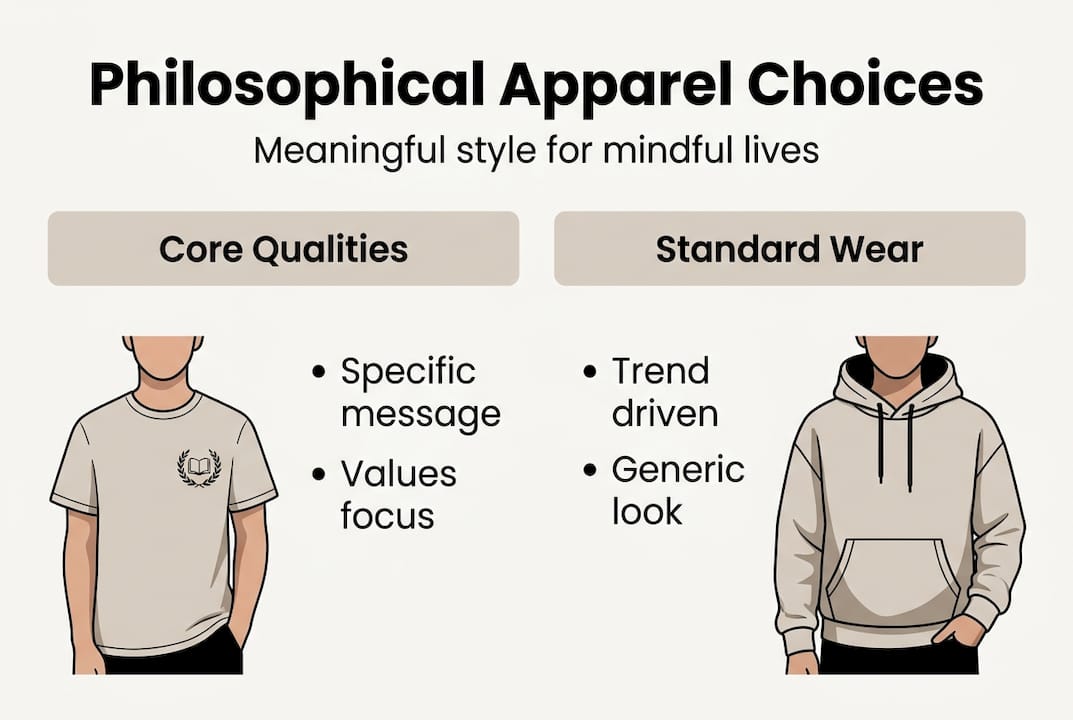
Comfort and ethical sourcing also matter. A garment you reach for regularly needs to feel good to wear. Check fabric composition, weight, and fit before purchasing. Ethical sourcing is increasingly relevant for buyers who want their values to extend beyond the message on the garment to the conditions under which it was made.
As enclothed cognition suggests, clothing can reinforce the person you want to become, which means the quality and integrity of the garment itself is part of that message.
Steps to build a minimalist, values-driven wardrobe:
- Audit your current wardrobe and identify pieces that carry no meaning for you.
- Remove or donate items that do not reflect your current values or aesthetic.
- Define two or three principles you want your wardrobe to represent.
- Select a small number of high-quality pieces that embody those principles.
- Resist adding items that do not meet your defined criteria, regardless of price or trend.
Pro Tip: Before purchasing any new piece, ask one question: does this garment remind me of something I want to carry with me today? If the answer is no, it is likely not the right addition to a values-driven wardrobe.
Browsing philosophical apparel collections with these criteria in mind makes the selection process more focused and less susceptible to impulse buying.
Why philosophy on your clothes is more than a trend
Fast fashion produces volume without meaning. Garments are made quickly, worn briefly, and discarded. Philosophical apparel sits at the opposite end of that spectrum, not because it is expensive, but because it is chosen with a specific purpose.
The deeper value of enclothed cognition is that it places agency in the wearer’s hands. You are not passively receiving a brand’s identity. You are actively selecting a principle and choosing to carry it. That is a meaningful shift in how clothing functions in daily life.
Values-driven dressing also challenges the idea that self-improvement requires grand gestures. Small, consistent choices compound over time. Choosing a garment that reflects who you want to be is one of those small choices. It costs little effort but contributes to a coherent sense of self.
Philosophical apparel is not about performing depth for others. It is a private, functional tool. The person next to you on the train may not know what your garment means. That is entirely the point. Living philosophy through fashion is ultimately a personal practice, not a public statement.
Discover apparel that reflects your philosophy
Memento Vivere produces clothing and accessories built around the stoic principle that everything passes and that awareness of this fact is a reason to live with greater intention. Each piece is designed with minimalist precision and genuine philosophical grounding.

The signature black motto hoodie carries the phrase Tutto Passa, Memento Vivere, a direct and considered statement for daily wear. For a broader selection of pieces built around the same ethos, the signature minimalist collection offers a range of options suited to urban lifestyles. Each item is designed for longevity in both construction and meaning.
Frequently asked questions
Does philosophical apparel really affect your mindset?
Research on enclothed cognition suggests that what you wear can influence your mindset and behaviour, making philosophical apparel a practical tool for self-improvement. The effect is linked to the symbolic meaning a wearer assigns to a garment.
How can I spot authentic philosophical fashion?
Look for minimalist, well-crafted designs featuring genuine quotes or philosophical symbols that reflect clear values and avoid empty slogans. Authentic pieces tend to be restrained in design and specific in meaning.
Is there scientific evidence for the benefits of enclothed cognition?
While large-scale data is limited, psychology research and many personal accounts support its mindset-shaping effects. The existing studies provide a credible basis for the concept, even if broader empirical benchmarks are not yet established.
Can philosophical apparel work for both work and leisure?
Yes, minimalist philosophy-inspired clothing adapts easily to both professional and casual settings, offering versatility and meaning. Clean design and neutral tones make it straightforward to incorporate into varied daily contexts.