
Minimalist accessories: Define your style with meaning
TL;DR:
- Minimalist accessories are versatile, high-quality, and emphasize intentional simplicity.
- They serve as personal reminders and tools for mindfulness and resilience.
- The market for minimalist jewelry is rapidly growing, driven by values and understated design.
Minimalist accessories are often dismissed as plain or forgettable. That assumption misses the point entirely. These pieces are thoughtfully designed, versatile items that do far more than complete an outfit. They bring clarity to daily decisions, support a mindful approach to living, and carry personal meaning that louder pieces rarely achieve. This guide covers what minimalist accessories actually are, why they resonate with a generation seeking purpose over excess, and how to choose pieces that genuinely reflect your values. Whether you are new to the concept or refining an existing approach, there is practical value here.
Table of Contents
- Understanding minimalist accessories: More than simplicity
- Meaningful accessories for resilience and mindfulness
- Market growth and trends: Minimalist accessories in 2026
- Minimalism vs. maximalism: Style, impact, and edge cases
- What most people miss about minimalist accessories
- Discover minimalist accessories that fit your mindful style
- Frequently asked questions
Key Takeaways
| Point | Details |
|---|---|
| Timeless quality matters | Minimalist accessories last longer because they focus on enduring materials and design. |
| Mindfulness in style | Intentional choices help foster resilience and mental clarity every day. |
| Versatility over quantity | Accessories chosen for neutral, subtle looks can match any outfit and reduce decision fatigue. |
| Strategic boldness | Minimalists occasionally use statement pieces for impact without losing the essence of simplicity. |
Understanding minimalist accessories: More than simplicity
Minimalist accessories are not simply accessories with less going on. They are defined by a clear set of principles: clean lines, neutral colours, and functional design. A piece qualifies as minimalist when it serves a purpose, avoids unnecessary ornamentation, and works across multiple contexts without demanding attention.
The philosophy behind this approach is well established. Minimalist accessories prioritise quality over quantity, timeless design, and functionality above trend-chasing. This is not a new idea. It draws from two major movements in design history.
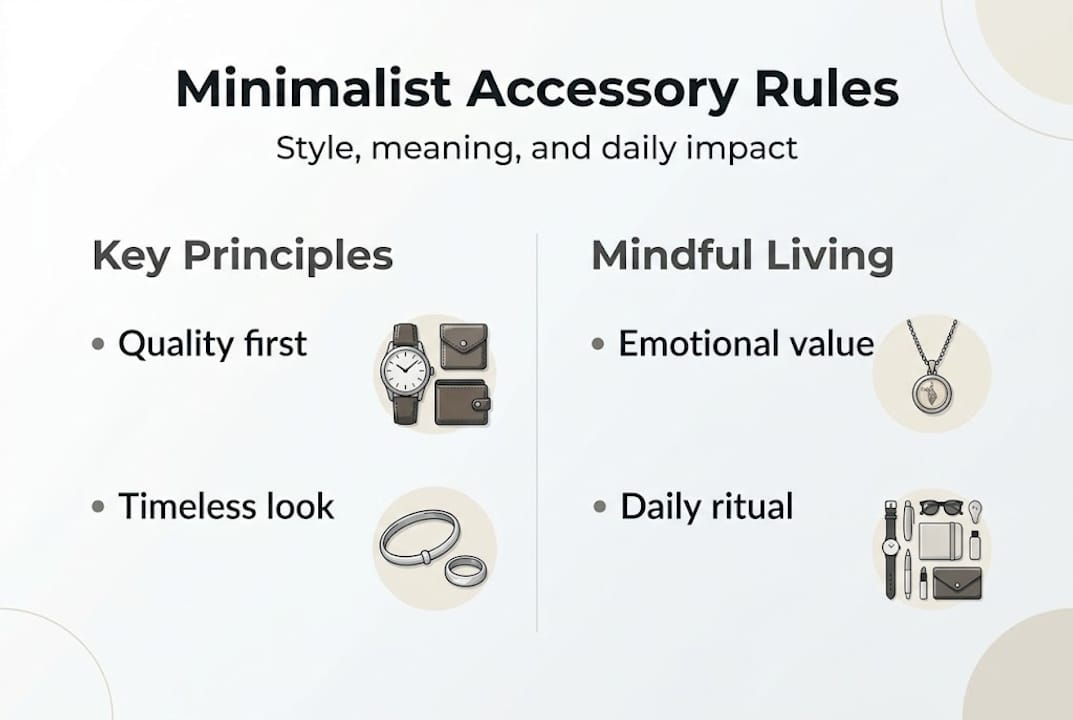
The first is Bauhaus, the German art school active from 1919 to 1933, which argued that form should follow function. The second is wabi-sabi, a Japanese aesthetic that finds beauty in imperfection and impermanence. Together, these traditions shaped what we now call the minimalist fashion philosophy. The ‘less is more’ principle rooted in both movements is also linked to reduced cognitive load and less decision fatigue, which matters in a world of constant visual noise.
Psychologically, wearing fewer, more considered pieces creates a sense of control. You are not overwhelmed by options each morning. You reach for what works, what means something, and you move on. This is the practical side of minimalism that rarely gets discussed.
“The most enduring accessories are not the loudest. They are the ones chosen with intention.”
Core traits of minimalist accessories include:
- Simple geometric or organic shapes
- Neutral or monochromatic colour palettes
- High-quality materials such as sterling silver, leather, or recycled metals
- Versatility across casual and formal settings
- Absence of logos or excessive branding
Examples include a plain gold band worn daily, a structured leather wallet, a classic analogue watch with a clean face, or a simple canvas bag. These are not boring choices. They are deliberate ones. Exploring a minimalist lifestyle guide can help clarify how these principles extend beyond fashion into broader daily habits.
Meaningful accessories for resilience and mindfulness
Once the philosophy is understood, the emotional dimension becomes clear. Minimalist accessories are not just about looking put-together. For many young adults, they serve as tangible anchors for mindfulness and resilience.
Bracelets engraved with phrases foster emotional resilience and act as tactile reminders during stressful moments. The physical act of touching or noticing a piece can interrupt anxious thought patterns and redirect focus. This is not abstract. It is a practical tool.

Choosing meaningful items creates daily reminders and supports anxiety relief through intentional design. A piece that marks a personal milestone, carries a phrase that matters, or features a symbol tied to your values does something a generic accessory cannot. It connects you to a specific intention every time you wear it.
This is particularly relevant for meaningful minimalist style as a practice. The accessory becomes part of a daily ritual rather than a fashion decision.
Pro Tip: When selecting a meaningful accessory, write down the specific intention or memory you want it to represent before purchasing. This prevents impulse buying and ensures the piece retains its significance over time.
Examples of accessories used in this way include:
- Engraved cuffs or bangles with personal phrases
- Rings featuring symbols tied to resilience or nature
- Minimalist pendants representing milestones such as travel, recovery, or growth
- Simple beaded bracelets with colour-coded meaning
- Watches given as gifts to mark significant transitions
The connection between stoic fashion resilience and minimalist accessories is worth noting. Stoic philosophy, which emphasises focusing on what is within your control and accepting what is not, aligns naturally with the minimalist approach. Wearing a piece that reflects this mindset is a quiet but consistent reminder of those values throughout the day.
Market growth and trends: Minimalist accessories in 2026
The appeal of minimalist accessories is not just philosophical. The numbers confirm a significant and sustained shift in consumer behaviour.
The minimalist jewellery market is projected to grow from $4.25 billion in 2024 to $7.80 billion by 2033, at a compound annual growth rate of 7.5%. This is one of the fastest-growing segments in the broader accessories market.
| Metric | Detail |
|---|---|
| Market value 2024 | $4.25 billion |
| Projected value 2033 | $7.80 billion |
| CAGR | 7.5% |
| Female consumer share | 75% |
| Earrings category share | 40% |
| North America market share | 35% |
Key demographic data shows that women account for approximately 75% of minimalist jewellery purchases, with earrings holding the largest single category share at 40%. North America leads regional demand at 35%, followed by Europe and a rapidly growing Asia-Pacific segment.
Among younger consumers, the trends driving this growth include:
- Accessories featuring mindful phrases or symbolic engravings
- Subtle, understated design over branded or logo-heavy pieces
- Eco-conscious materials including recycled metals and sustainably sourced stones
- Capsule accessory wardrobes built around three to five core pieces
Exploring minimalist jewellery trends in 2026 shows a clear move towards pieces that carry narrative weight. Consumers are not just buying accessories. They are buying objects that represent something about who they are and how they choose to live.
This shift is particularly visible in the 18 to 30 age group, where purchasing decisions are increasingly driven by values alignment rather than brand recognition alone.
Minimalism vs. maximalism: Style, impact, and edge cases
Understanding minimalist accessories is easier when compared directly to the maximalist alternative. Both approaches have merit. The choice depends on context, personality, and intent.
Minimalist accessories whisper sophistication and versatility, while maximalist trends communicate drama and boldness. Neither is objectively superior. They serve different purposes and suit different moments.
| Feature | Minimalist | Maximalist |
|---|---|---|
| Shape | Clean, geometric | Layered, ornate |
| Colour palette | Neutral, monochromatic | Bold, mixed |
| Intent | Understated, versatile | Statement, expressive |
| Occasion | Daily wear, professional | Events, creative contexts |
| Maintenance | Low | Higher |
For those committed to minimalism, layering or using a bold statement piece occasionally adds visual interest without creating clutter. This is a practical middle ground that many experienced minimalists use.
Pro Tip: If you are unsure whether a piece fits a minimalist approach, ask whether it works with at least five different outfits in your current wardrobe. If it does not, it is likely too specific or ornate for a minimalist toolkit.
How to choose between styles based on situation:
- For daily wear and professional settings, lean towards clean, simple pieces in neutral tones.
- For social events or creative environments, one deliberate statement piece can elevate an otherwise minimal look.
- For days requiring focus and calm, consider wearing no accessories at all. This is a valid and often underestimated option.
- When building a capsule collection, start with three foundational pieces and add only when a clear gap exists.
- Assess the occasion, your outfit’s existing visual weight, and your mood before selecting.
Minimalist streetwear self-expression often combines clean silhouettes with one or two accessories that carry symbolic weight. Understanding symbolism in minimalist accessories helps in making selections that feel intentional rather than arbitrary.
What most people miss about minimalist accessories
The most common misunderstanding about minimalism in fashion is that it is about restriction. It is not. Minimalism is an active, ongoing set of choices. Each decision to wear less, or to wear something specific, is deliberate. That is the opposite of passive.
Many people adopt a minimalist approach expecting it to feel limiting. What they find instead is that it creates space. Fewer decisions each morning. Clearer personal identity. Less noise between you and what actually matters during the day.
Resilience and clarity are central to the appeal for young adults navigating significant life transitions. An accessory that carries meaning does not require explanation. It works quietly. Following mindful streetwear trends in 2026 shows that this quiet intentionality is becoming a defining characteristic of the generation, not a niche preference.
It is also worth noting that embracing minimalism can include occasional boldness or even days with no accessories at all. Both are valid expressions of the same philosophy.
Discover minimalist accessories that fit your mindful style
The principles covered in this guide point towards one practical outcome: choosing accessories with intention, quality, and personal meaning. Memento Vivere Co offers a range of pieces designed with exactly this approach in mind.
The signature minimalist backpack and signature drawstring bag are built for daily use, combining clean design with functional construction. For those extending their minimalist approach to apparel, the signature white hoodie carries the Tutto Passa, Memento Vivere message in a straightforward, wearable format. Each piece is designed to complement a considered, minimal wardrobe without demanding attention.
Frequently asked questions
What defines a minimalist accessory?
Minimalist accessories are simple, clean-lined, versatile pieces that prioritise quality, functionality, and timeless appeal over trend-driven design.
How can minimalist accessories support mindfulness?
Minimalist accessories resonate with resilience and mindfulness by serving as daily reminders of intentional living, particularly when engraved with meaningful phrases or symbols.
Is minimalist style only about jewellery?
Minimalist accessories extend well beyond jewellery to include bags, belts, watches, and other items, all selected for versatility and understated elegance.
Can minimalists use statement pieces?
Even minimalists use statement accessories sparingly for impact, or choose no accessories at all on days when simplicity serves better than any addition.
Recommended
- Why embrace minimalist style: Meaningful fashion for mindful lives – Memento Vivere Co
- Minimalist streetwear: Self-expression for urban youth – Memento Vivere Co
- Why wear meaningful clothing: stoic fashion for resilience – Memento Vivere Co
- Minimalist fashion: examples, brands and philosophy – Memento Vivere Co