
Tattoo-style design: meaningful art meets minimalist fashion
TL;DR:
- Tattoo-style design integrates bold lines, geometric motifs, and symbolism into fashion and branding.
- Longevity depends on bold, simple compositions and planning for garment contours and wear over time.
- Meaningful symbols communicate personal philosophy, with minimalism enhancing clarity and lasting impact.
Many assume tattoo-style design belongs exclusively to parlour chairs and permanent ink. That assumption misses a significant shift in how tattoo aesthetics now inform graphic design, clothing, and personal philosophy. Bold line work, geometric motifs, and fine detail have moved well beyond skin. They now appear on garments, accessories, and brand identities worn by people who value meaning in what they carry daily. This guide covers what tattoo-style design actually is, how its core methods translate into wearable fashion, which symbols matter most, and how to apply these principles practically to create clothing with lasting impact.
Table of Contents
- What is tattoo-style design?
- Core methodologies: From ink to apparel
- Symbols and their meaning in minimalist tattoo-inspired fashion
- Practical application: Creating impactful tattoo-style clothing
- The overlooked nuances in tattoo-style design for modern creatives
- Explore meaningful tattoo-style apparel and accessories
- Frequently asked questions
Key Takeaways
| Point | Details |
|---|---|
| Minimalism drives meaning | Reducing tattoo-inspired designs to just a few carefully chosen elements can make fashion statements that feel deeply personal. |
| Adapt tattoo methods | Using line flow, contrast, and scalable graphics borrowed from tattoo art improves both the look and wearability of clothing prints. |
| Symbols connect philosophy | Geometric shapes and fine line florals in minimalist fashion serve as powerful philosophical reminders for creative individuals. |
| Design for longevity | Bold lines and symmetry help tattoo-style prints stay vibrant and undistorted as apparel ages and styles change. |
| Practical tools boost engagement | Locked colour palettes and custom mockups are proven to increase social engagement and conversion for tattoo-style merchandise. |
What is tattoo-style design?
Tattoo-style design is not simply a reproduction of tattoo imagery on fabric. It is a distinct visual language with its own rules, priorities, and aesthetic logic. Tattoo-style design in graphic and fashion contexts adapts tattoo aesthetics like bold lines, geometric shapes, fine line work, and symbolic motifs into prints, logos, and clothing graphics, emphasising minimalism and meaning. The result is design that carries conceptual weight without visual clutter.
The key features of tattoo-style design in fashion include:
- Bold outlines that define form clearly at any scale
- Geometric structures such as triangles, mandalas, and grid patterns
- Fine line work for intricate detail within minimal compositions
- Symbolic motifs drawn from nature, philosophy, and cultural history
- High contrast between figure and background for legibility
- Negative space used deliberately to give weight to what remains
This approach differs considerably from traditional fashion print styles, which often prioritise decorative repetition or photographic imagery. Tattoo-style design, by contrast, prioritises intention. Each element earns its place.
“Design that removes everything unnecessary leaves only what matters.”
The table below compares tattoo-style design with two adjacent approaches:
| Feature | Tattoo-style design | Classic tattoo art | Standard fashion print |
|---|---|---|---|
| Line weight | Variable, deliberate | Heavy, traditional | Often absent |
| Symbolism | Central | Present | Decorative |
| Minimalism | High | Low to medium | Variable |
| Scalability | Optimised | Limited | High |
| Conceptual depth | High | High | Low to medium |
Exploring tattoo-inspired art styles reveals how these distinctions play out across different creative disciplines. The core principle remains consistent: reduce to essentials, then make those essentials mean something.
Core methodologies: From ink to apparel
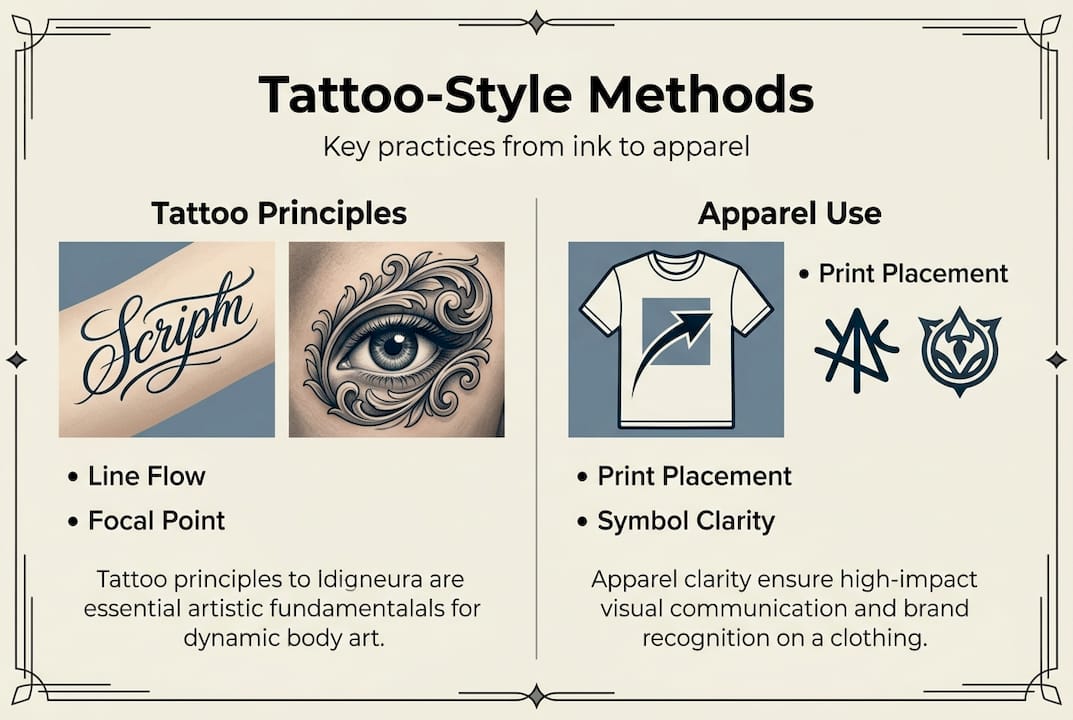
Transferring tattoo design principles to clothing requires more than copying an image onto a garment. The methodology must account for different surfaces, production constraints, and viewing distances. Core methodologies in tattoo composition use movement and flow via lines and geometric guides, emphasis on focal subjects, body and anatomy consideration, contrast for depth and legibility, and dynamics through transitions. Each of these principles adapts directly to garment design.
The following steps outline how experienced designers move from concept to wearable print:
- Define the focal point. Identify the single element that carries the most meaning. Everything else supports it.
- Map movement with line guides. Diagonal and curved lines create visual flow across the garment surface, preventing static compositions.
- Plan for garment curves. Flat artwork distorts on three-dimensional forms. Account for seams, folds, and body contours during the design phase.
- Build contrast deliberately. High contrast between print and fabric ensures legibility across lighting conditions and washing cycles.
- Test at multiple scales. A design that reads well at A4 size may lose detail at chest-print scale. Use vector formats throughout.
- Limit the palette. Fewer colours reduce production complexity and strengthen visual coherence.
The table below shows how tattoo composition principles map to garment design decisions:
| Tattoo principle | Garment application |
|---|---|
| Flow via line guides | Print placement across seams |
| Focal emphasis | Chest or back centrepiece |
| Anatomy consideration | Curve-adjusted artwork |
| Contrast for legibility | Fabric colour selection |
| Tonal transitions | Gradient or layered print |
Pro Tip: Use SVG vector files for all tattoo-style print artwork. SVG formats scale without quality loss, and pairing them with WCAG-compliant colour contrast ratios ensures your prints remain sharp and accessible across all production runs.
For broader context on building cohesive wardrobes around these principles, timeless streetwear and minimalist streetwear offer practical framing. Detailed design planning advice covers the reference-to-finished-piece process in further depth.
Symbols and their meaning in minimalist tattoo-inspired fashion
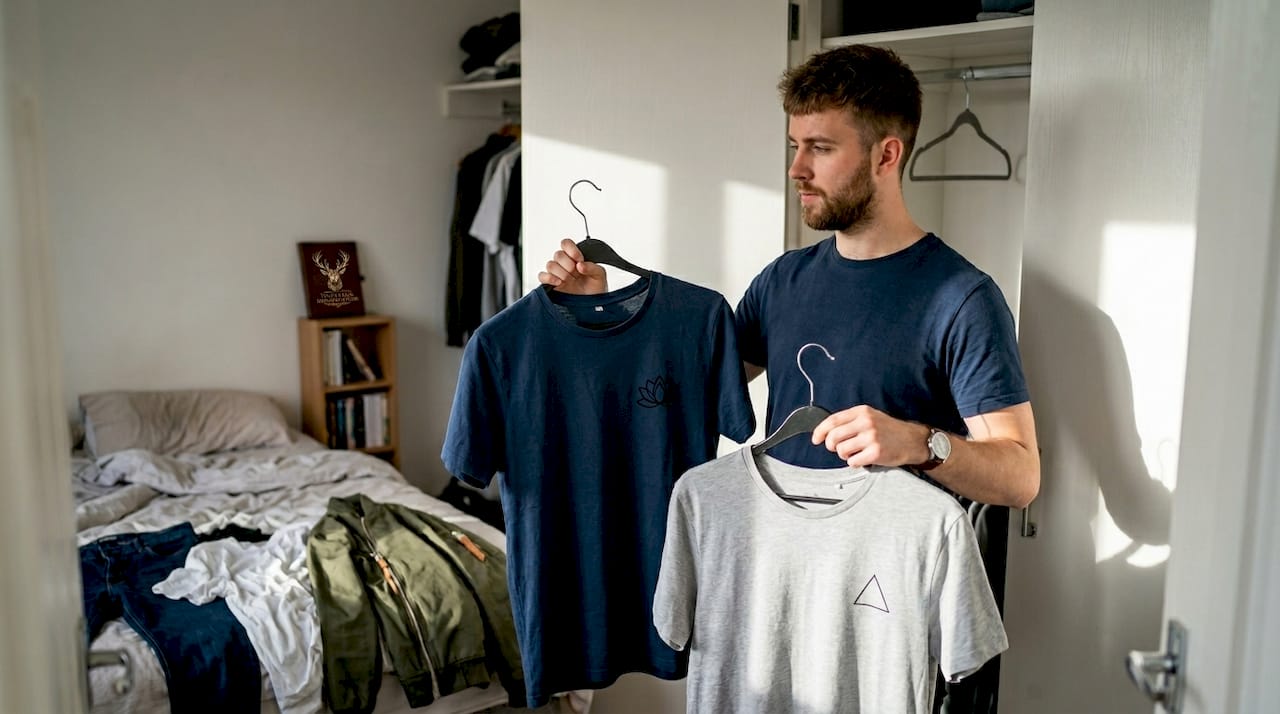
Symbolism is not decorative in tattoo-inspired fashion. It is structural. The choice of motif communicates something specific about the wearer’s values, philosophy, or personal history. Meaningful symbols in this context include geometric forms such as triangles representing change and circles representing unity, fine line florals including the rose for love and the lotus for purity, and abstract icons that carry secret meanings in minimalist forms for personal philosophy.
Commonly used symbols in minimalist tattoo-inspired fashion include:
- Triangle pointing upward: strength, ambition, forward movement
- Circle or ring: unity, continuity, wholeness
- Stag or deer: resilience, awareness, renewal, independence
- Lotus flower: purity emerging from difficulty
- Rose: love, beauty, the passage of time
- Vesica piscis: balance, duality, sacred geometry
- Single line portrait: identity reduced to its essential form
The stag, in particular, carries layered meaning across multiple cultural traditions. It represents the ability to move through changing seasons with awareness and strength. As a central motif in stoic-inspired fashion, it communicates something that words rarely do as efficiently.
“A symbol says in one image what a paragraph cannot say in ten sentences.”
The depth of symbolism in fashion extends well beyond decoration. Symbols function as personal philosophy made visible. For those embracing minimalist style, the choice of a single meaningful motif over complex imagery is itself a statement. Less noise. More signal.
For additional context on the philosophy behind minimal tattoo symbolism, minimalist tattoo philosophy provides a useful reference point.
Pro Tip: Single-needle and fine line icons reproduce exceptionally well on lightweight fabrics. They retain clarity at small sizes and age gracefully with the garment, making them a practical choice for prints intended to remain relevant across multiple seasons.
Practical application: Creating impactful tattoo-style clothing
Theory only carries value when it produces results. The following steps provide a practical framework for designing or selecting tattoo-style clothing with genuine impact.
- Extract a colour palette from the core motif. Tools such as Coolors.co allow designers to build palettes of three to five colours directly from reference artwork. Maintain a minimum contrast ratio of 4.5:1 between print and background for legibility.
- Select typography that matches the design weight. Bold typefaces such as Bebas Neue or Montserrat complement tattoo-style graphics without competing with them.
- Apply subtle watermark-style prints for versatility. A large-scale, low-opacity version of the primary motif across the back or chest adds depth without overwhelming the composition.
- Use custom mockups for presentation. Placing artwork on accurate garment templates helps identify scale and placement issues before production.
- Lock the palette across all products. Consistency across a collection strengthens brand recognition and visual coherence.
Empirical benchmarks from studio data show a 12% social engagement rise from consistent palettes, a 12% conversion increase from custom mockups, and 30% more profile clicks from artist cards. These figures apply directly to fashion brands using tattoo-style design in their marketing.
For minimalistic fashion and clothing, extracting palettes from tattoo art using tools like Coolors.co for three to five colours with contrast above 4.5:1, pairing with bold typography, and applying subtle watermark prints on garments produces consistently strong results.
The guide to mindful fashion and minimalist lifestyle guide offer further context on building a wardrobe that reflects considered values. For practical examples of how tattoo logo in streetwear translates across brand identities, the reference covers a wide range of real-world applications.
The overlooked nuances in tattoo-style design for modern creatives
Most guides focus on the visual appeal of tattoo-style design. Fewer address the technical realities that determine whether a design lasts or deteriorates.
Edge cases and expert nuances confirm that fine line work fades faster, with up to 20 to 30% brightness loss over time, requiring a steady hand and single-needle technique. Geometric designs need careful symmetry planning to avoid distortion on curved surfaces. Bold lines consistently outperform fine detail for longevity in printed applications.
This has a direct implication for clothing design. Fine line prints look exceptional when new. After repeated washing and wear, they lose definition faster than bold compositions. Designers who prioritise longevity choose heavier line weights and simpler geometric structures. The result is a garment that remains visually coherent after two years, not just two weeks.
Geometric symmetry is particularly critical on garments. A mandala that reads as perfectly balanced on a flat artboard will distort across chest curves and side seams. Planning for this during the artwork stage, rather than after production, prevents costly errors.
Bold minimalism outlasts trends for a practical reason. It does not rely on cultural references that expire. A strong geometric motif with clear symbolic meaning carries value independently of whatever aesthetic is currently popular. That is why mindful tattoo art consistently returns to these foundational principles rather than chasing surface-level trends.
Explore meaningful tattoo-style apparel and accessories
The principles covered in this article are directly applied across the Memento Vivere collections. Each piece uses tattoo-style design with deliberate symbolism, minimal composition, and considered placement. The stag motif, bold line work, and stoic-inspired messaging form the foundation of every product.
The signature collection brings these design principles into a focused range of apparel and accessories. Each item is produced with attention to print longevity, fabric quality, and symbolic clarity. Pieces are available to browse, compare, and purchase directly through the site. No subscription or account is required to place an order.
Frequently asked questions
How is tattoo-style design different from traditional tattoos?
Tattoo-style design adapts tattoo aesthetics such as bold lines, geometric shapes, and symbolic motifs into prints and clothing graphics, prioritising minimalism and meaning rather than detailed traditional ink applied to skin.
Which symbols are most popular in tattoo-inspired fashion?
Triangles representing change, circles representing unity, and fine line florals such as roses and lotus flowers are most common, selected for their minimalism and capacity for personal meaning.
How do designers ensure tattoo-style prints stay bold and crisp over time?
Designers favour bold lines and plan for geometric symmetry, as fine line work loses 20 to 30% brightness over time. Scalable formats and high contrast ratios maintain print clarity through repeated washing and wear.
What practical steps help make tattoo-style apparel engaging?
Studio data shows that locked colour palettes and bold typography produce a 12% social engagement rise, while custom mockups improve conversions by 12% and artist cards generate 30% more profile clicks.
Recommended
- Tattoo-inspired art: Styles and meaning for mindful design – Memento Vivere Co
- Minimalist streetwear: Self-expression for urban youth – Memento Vivere Co
- Why embrace minimalist style: Meaningful fashion for mindful lives – Memento Vivere Co
- How to incorporate symbolism in fashion for style – Memento Vivere Co